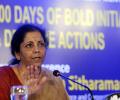
Finance Minister Nirmala Sitharaman has called for enhanced accountability and safeguards for artificial intelligence, particularly as it integrates into critical sectors like finance. Speaking at the Global Fintech Fest, she highlighted the dual nature of AI, capable of accelerating transactions but also amplifying fraud and cyberattacks. Sitharaman stressed the need for human and institutional responsibility in AI-driven decisions, urging regulators and companies to scrutinise high-risk AI applications. She also proposed a federated industry platform for Indian tech companies to navigate international regulations and ensure tax compliance globally.

HSBC has emerged as the leading international bank in facilitating fundraising for Indian companies through bonds, syndicated loans, and IPOs during January-September 2026, according to Hitendra Dave, CEO of HSBC India.
'The Rs 35,000 crore of capex every year, I don't get to sign 35 paise out of this.'

Reserve Bank of India (RBI) Deputy Governor Rohit Jain has warned that financial institutions' increasing reliance on a small number of common technology providers, including cloud and AI model providers, could create a new source of systemic risk. He highlighted 'speed, concentration and opacity' as key risks, noting that a disruption at one provider could rapidly spread across multiple institutions, amplifying existing financial risks.

BRICS finance ministers and central bank governors have called for increased representation of emerging-market and developing economies in the IMF and World Bank, while also criticising unilateral tariffs and trade measures, as the expanded bloc aims to bolster financial cooperation amidst global fragmentation.

The Finance Ministry has refuted allegations that US pressure influenced the decision to levy a 0.4 per cent Merchant Discount Rate (MDR) on select UPI payments. The ministry clarified that the NPCI guidelines prioritise RuPay credit cards on UPI to promote domestic alternatives and ensure a self-sustaining revenue model for smaller domestic companies, countering claims of favouring foreign payment providers.

Jio Platforms Ltd's Rs 30,213-crore initial public offering was subscribed 3.01 times, attracting approximately Rs 66,500 crore in public bids, with qualified institutional buyers oversubscribing their portion by 9.02 times, while retail investor demand remained under-subscribed at 0.68 times.

Institutional portion subscribed 12.68 times; retail crosses quota.

Indian stock markets witnessed a significant rebound, with the Sensex rallying 1,109 points and the Nifty closing above 22,720, driven by strong performances in IT and financial sectors, a recovering rupee, and Finance Minister Nirmala Sitharaman's comments on long-term capital gains (LTCG) tax.

Indian companies, including NBFCs, filed proposals to raise $7.696 billion through external commercial borrowings (ECBs) and foreign currency convertible bonds (FCCBs) in July 2026, a significant increase from $6.09 billion in June.

Dedicated Ayush dispensaries increased from 26,130 in 2013-2014 to 37,804 in 2024-2025, while hospitals rose much more slowly, from 3,605 to 3,885.

Indian benchmark indices Sensex and Nifty experienced volatile trading, influenced by elevated crude oil prices, high US bond yields, and selling pressure in IT stocks, despite an early rebound.

India's private sector capital expenditure is projected to reach approximately 3.2 trillion in the financial year 2026-27, up from 2.6 trillion in FY26, according to a Reserve Bank of India bulletin report, indicating sustained confidence despite global uncertainties.

Indian benchmark indices, Sensex and Nifty, experienced a significant drop in early trade, with the Sensex falling over 600 points, primarily due to crude oil prices surging past the USD 100 per barrel mark and weak global market trends. Track Sensex, Nifty on September 24.

'For Indian institutions this year, global peers are outpacing in key areas such as RoI, entrepreneurship, and alumni outcomes.'

The Pakistan Cricket Board has filed a petition in the Islamabad High Court against the Pakistan Information Commission's directive to disclose its confidential financial records, player contracts, and employee salary details. The PCB argues that such disclosure would harm its commercial interests and contractual negotiations, as it operates in a competitive international environment and does not receive government funding.

Finance Minister Nirmala Sitharaman announced that the Goods and Services Tax (GST) Council's October 7 meeting will focus on 'GST 2.0' process reforms, including e-invoicing and input tax credit rules, while also addressing complex issues surrounding the taxation of the digital economy and cryptocurrency.

The search for N Chandrasekaran's successor as Tata Sons Chairman has reportedly narrowed to Tata Steel CEO T V Narendran, Tata Sons Executive Director Saurabh Agrawal, and NSE MD & CEO Ashish Chauhan, with Chauhan emerging as a potential 'dark horse' candidate.

External Affairs Minister S Jaishankar, addressing the UN General Assembly, condemned the targeting of commercial shipping and seafarers in the Gulf, calling it "simply unacceptable." He also voiced deep concern over the "weaponisation of everything," which he stated has severe consequences for Global South nations, impacting peace, progress, and development globally. India urged restraint, de-escalation, and protection of civilians, while also highlighting the 4F crisis (food, fuel, fertiliser, finance) faced by developing countries.

Indian benchmark equity indices, Sensex and Nifty, closed higher on Monday, driven by softer-than-expected US jobs data which reduced expectations of aggressive monetary tightening by the US Federal Reserve, boosting risk appetite across emerging markets.

Chief Election Commissioner Gyanesh Kumar is facing significant scrutiny after an investigation revealed objections from his fellow election commissioners, Sukhbir Singh Sandhu and Vivek Joshi, regarding decisions made during the Special Intensive Revision of voter lists. The objections, reportedly made at least 14 times, concerned issues like changes to voter registration forms and centralised control over electoral roll databases, intensifying criticism of Kumar's tenure and the EC's impartiality.

India is actively integrating payment system harmonisation into its Free Trade Agreement (FTA) negotiations, especially with countries hosting a large Indian diaspora. This strategy aims to leverage India's growing fintech ecosystem, facilitate cross-border financial services, and position India as a global hub for financial services exports, particularly through platforms like GIFT City.

A career break does not erase the experience that came before it. But the labour market can act as though it does. The more women invest in building professional careers, the more costly an interruption can become. How, then, do we enable women to make a comeback? Whose responsibility is it? asks Radha Roy Biswas.

A two-day weekend would help employees recover physically and mentally. They would return better prepared for branch work that demands patience, judgment, and accuracy, asserts Tamal Bandyopadhyay.

For India, the goal is not simply to host another grand diplomatic gathering. It is to prove that a diverse coalition of emerging powers can still deliver.

Indian benchmark equity indices, Sensex and Nifty, experienced declines in early trade due to renewed tensions in West Asia, which led to a rebound in crude oil prices, coupled with weak global market trends and foreign fund outflows.

Indian companies, including NBFCs, filed proposals with the RBI to raise $6.08 billion through external commercial borrowings (ECBs) and foreign currency convertible bonds (FCCBs) in June, marking a significant increase from the previous month.

Indian benchmark equity indices extended their losing streak for a fourth consecutive day, with the Sensex tumbling 417 points due to rising crude oil prices and a significant sell-off in IT stocks, impacting overall investor sentiment.

Russian President Vladimir Putin has proposed a new investment platform, based on the New Development Bank (NDB), to fund projects in trade, infrastructure, logistics, and technology across BRICS nations, emphasising that the grouping's expanding economic cooperation is not 'against anyone' but aims to advance members' national interests.

Chinese President Xi Jinping's upcoming visit to India for the BRICS summit is a pivotal diplomatic event poised to significantly impact bilateral ties and global cooperation amidst ongoing international instability.

The FCNR (B) stratagem relies on using public money to defend the rupee. The State subsidises foreign borrowing to attract dollars. This tool requires large-scale borrowing to make a material difference against a gross external flow of $11 billion a day. A commensurately large fiscal cost falls upon the exchequer. The ministry of finance will choose how much it is willing to spend in exchange for this round number, points out Ajay Shah.

Union Finance Minister Nirmala Sitharaman announced the government's plan to establish a high-powered committee to examine reforms for the banking sector, aligning it with the vision of a 'Viksit Bharat' (Developed India) and India's next phase of growth.

India and China are in what experts call 'a cooperation-versus-competition situation'.

Finance Minister Nirmala Sitharaman urged PSBs to become 'cool' and shed their 'government bank' image to attract young customers.

Major General Faisal Naseer, infamously dubbed 'Dirty Harry' for his controversial tenure in the ISI, has been appointed national co-ordinator of Pakistan's National Counter-Terrorism Authority.

'Improved law and order and transparent governance have helped change UP's investment image.'

The Indian Super League (ISL) 2024-25 season has been postponed to after October 6 due to the FIFA international match window, and will proceed with 13 teams after Diamond Harbour FC failed to meet payment deadlines. Concurrently, the All India Football Federation (AIFF) has condemned "unverified claims" regarding its finances and the decision to withdraw from the FIFA ASEAN Cup, asserting that the prioritisation of a friendly match against Brazil was a strategic move for Indian football.

The challenge for India lies in navigating complex landscape to its best advantage. The BRICS Summit will test its navigation skills, asserts former foreign secretary Shyam Saran.

US President Donald Trump is expected to sign the Lindsey O. Graham Sanctioning Russia and Iran Act of 2026 later on Friday (local time). A White House official confirmed the development to ANI without revealing further details.

Indian physicist Deepak Dhar, a professor at ICTS-TIFR in Bengaluru, has been awarded the prestigious 2026 Dirac Medal for his significant contributions to statistical mechanics. He shares the honour with three other physicists for their work on understanding complex systems, with applications in diverse fields like biology, finance, and AI. Dhar is particularly recognised for his "sandpile model" and has previously received the Padma Bhushan and Boltzmann Medal.
